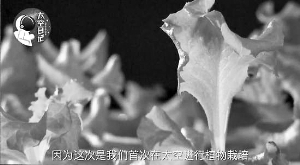

Chinese astronauts Jing Haipeng and Chen Dong have lived in the "two-bedroom" of Tiangong-2 and Shenzhou-11 for more than 20 days, and this space trip is coming to an end. In the busy life and work in space, the two astronauts also experienced the feeling of being a vegetable farmer. They planted nine lettuce trees the day after they entered their new home in space, and now they are growing well. However, this time the astronauts haven’t had a chance to taste the vegetables they planted, and they will return to earth with the astronauts in a few days.
How to use it?
Collect data as experimental samples.
The primary task of space life in the future is to solve food self-sufficiency. Can the green plants on the earth grow normally in the space environment, thus providing human beings with food and oxygen sources? In this mission, two astronauts, Jing Haipeng and Chen Dong, conducted the whole process of planting, cultivating and harvesting plants in space for the first time.
The reason why lettuce is brought into space is that the growth cycle of lettuce is just 30 days, which coincides with the resident time of astronauts in Tiangong, and it has strong environmental adaptability, so it has become the first plant to be cultivated in space in China. The plants planted this time will not be eaten, but will be used as experimental samples to collect relevant data. Only after passing the test will astronauts be considered to eat cultivated vegetables in the next experiment.
It is understood that as early as 2009, Russian astronauts began to grow vegetables on the space station, but space vegetables were never eaten for fear of being polluted by cosmic microorganisms. Last August, the astronauts of the International Space Station tried lettuce grown in a greenhouse vegetable garden for the first time. The astronauts said, "It’s delicious."
How to raise it?
Take care of lettuce for 10 minutes every day
In the past few days, Jing Haipeng has done some routine care work for the cultivated lettuce, mainly detecting the moisture content and nutrient content of the cultivation substrate, lighting and pushing air into the substrate with a syringe. The instrument can detect the moisture content. If the index is low, it means that lettuce needs to be watered. Injecting air is to let the roots of lettuce breathe fresh air, which is beneficial to the growth of plants. The two astronauts are like "farmers" in space, spending at least 10 minutes every day to take care of lettuce.
In addition, the substrate used to grow lettuce in space is different from the soil on the ground. They use mineral vermiculite. Its water absorption is very good, and the water conduction in it is very uniform, even under the condition of gravity on the ground, the upward adsorption is very smooth; In addition, it has low density and light weight, and is easy to carry to the sky.
How to plant it?
The device is made of 3D printed nylon material.
The cultivation device for planting lettuce in space is also unusual. The white box built by cells is 3D printed and made of nylon, which is relatively light. White and green form a sharp contrast and the visual effect is also very good. There are two devices on it, one is used to measure the water and nutrient parameters in the soil, and the other is used to measure the photosynthesis of plants in the closed condition at the later stage of plant growth.
The way of sowing in the sky is different from that on the ground. Generally, the ground is sown first and then watered. However, because the white cell is a hard material, the seeds can only be put in after it is softened by water absorption, so it is watered first and then sown.
On the morning of the fifth day of the combination of Tiangong-2 and Shenzhou-11, the astronauts found the seeds sprouted, and quickly took a group photo with the lettuce buds as a souvenir. After that, the lettuce is provided with light, which is made up of three colors: red, blue and green, mainly red. Lettuce absorbs red light very efficiently and grows well under red light irradiation. Green light is used because it shines on lettuce leaves and the visual effect is very good; Blue light has a strong effect on plant morphological stretching.
How long?
Space lettuce also grows upward.
Lettuce begins to turn green under the action of light after it enters the growth period. Carefully thinning seedlings and replenishing water with tweezers has become the daily work of "space farmers". In addition, astronauts also need to observe and take photos of lettuce every day to check the moisture content and nutrient content of the substrate.
Some netizens asked, will the direction of lettuce growth change in space? Jing Haipeng said that lettuce planted in space is the same as the ground, and it grows upward, and it seems to be higher than the ground. Although space is a weightless environment, plants are still growing upward because of their phototaxis; At the same time, the plant also has the characteristics of water and fertilizer, and its roots will grow towards the substrate rich in water and nutrients.
Tomorrow is the last day for astronauts to plant vegetables in orbit. At that time, they will take plant samples, cut off the leaves and roots of lettuce, put them in a low-temperature storage device and bring them back to the earth.
Beijing Morning Post reporter Han Na