Tired of the fatigue caused by frequent shifting of manual transmission in urban congested road conditions, and losing confidence in the shift consistency and reaction speed of automatic transmission, we need a transmission with better performance and more accurate control to achieve perfect shift feeling. The appearance of dual clutch transmission meets our demand.
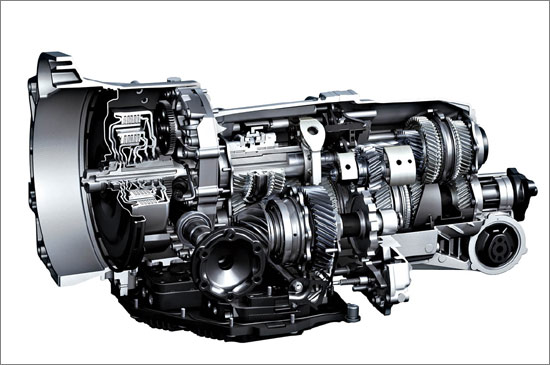
What is a dual clutch transmission?
Dual-clutch transmission, as its name implies, is a transmission that uses two clutches, and each clutch operates independently. One clutch controls odd gears and the other clutch controls even gears. When the car is running normally, one clutch is connected to a certain gear in the transmission to transmit the engine power to the driving wheels. At the same time, the control unit pre-judges the driver’s shift intention according to the vehicle speed and engine speed, and "predictively" controls the other clutch to be connected to the gear set of the next gear in the transmission. However, at this time, it is only in the "pre-engagement" state, and the clutch is still in the separation state, without any power transmission. When shifting gears, the first clutch is disconnected, and at the same time, the second clutch engages the gear set of the next gear in the previously pre-connected transmission with the engine to transmit the power of the next gear, so that the power will not be interrupted. Except for neutral, one clutch in a dual clutch transmission is always in the engaged state and the other clutch is always in the disengaged state.
Difference between Dual Clutch Transmission and Manual Transmission and Automatic Transmission

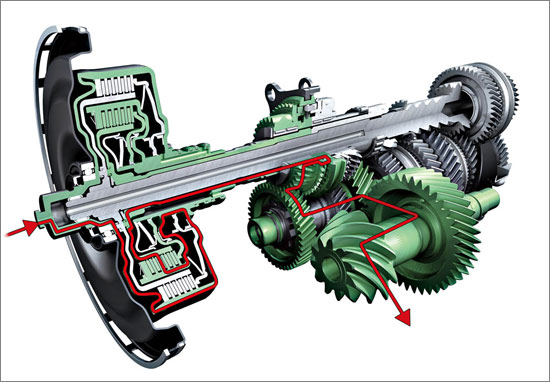
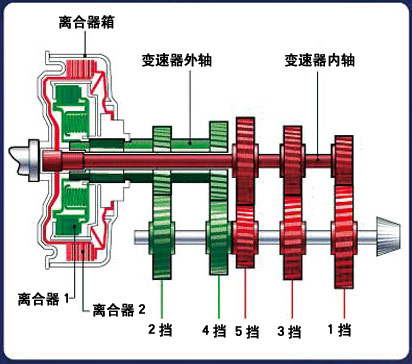
It can be clearly seen from the figure that the blue part indicates that the clutch 2 controls the odd gears in the transmission through the inner shaft, and the green part indicates that the clutch 1 controls the even gears in the transmission through the outer shaft. The arrow in the figure indicates the direction of power transmission.
The dual clutch transmission omits the clutch pedal of the traditional manual transmission, and the electronic control hydraulic system is used to control the two clutches. In addition, the input shaft of the dual-clutch transmission is also divided into two parts. The two clutches are connected to one input shaft, the hollow outer shaft is used to connect even gears in the transmission, and the solid inner shaft embedded in the outer shaft sleeve is used to connect odd gears. The two clutches cooperate with each other when working, and each clutch is responsible for the power transmission of an input shaft, so as to realize the uninterrupted power output.
It can be seen that the dual clutch transmission is not much different from the ordinary automatic transmission in use, but its internal structure is more similar to the traditional manual transmission, so it also inherits the dual technical advantages of reliable manual transmission and simple operation of automatic transmission.
Application of dual clutch transmission
Dual clutch transmission will be the main direction of transmission technology development in the future because of its dual technical advantages of reliable manual transmission and convenient automatic transmission operation. However, as far as the current situation is concerned, the dual-clutch transmission has not been widely used in modern vehicles because of its complicated structure and high cost of maintenance and accessories, and has only been applied in individual vehicles. Next, I will introduce several dual-clutch transmissions currently equipped in automobiles, as well as their structural characteristics and technical advantages.
Volkswagen DSG dual clutch transmission
DSG dual clutch transmission is a new technology introduced by Volkswagen. DSG is the English abbreviation of "DirectShiftGearbox", which means "direct shift transmission" in Chinese, and adopts the internal structure design of double clutches. It combines the functions of traditional manual transmission and automatic transmission, and integrates their respective technical advantages. In DSG dual-clutch transmission, one clutch controls the gear set of odd gears in the transmission, and the other transmission controls the gear set of even gears. When the transmission is put into 1st gear, the 2nd gear set is engaged. When shifting gears, the first clutch is disconnected, and the second clutch engages the previously engaged 2nd gear set with the output shaft of the engine and shifts to 2nd gear. At the same time, the 3rd gear set controlled by the first clutch is also engaged, waiting for the next shift instruction.
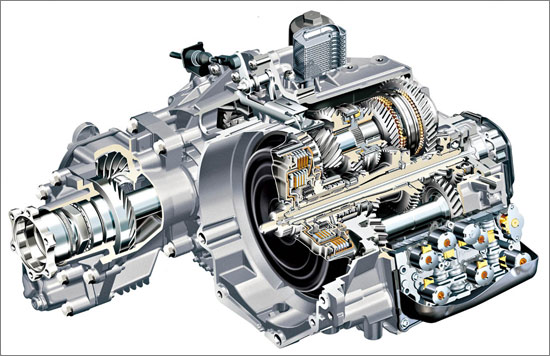
Volkswagen DSG dual clutch transmission
Because the DSG dual clutch transmission omits the clutch pedal of the traditional manual transmission and the torque converter of the automatic transmission, its multiple wet dual clutches are controlled by the electronically controlled hydraulic system located at the top of the transmission, so its response is very sensitive and it has good driving pleasure. The application of dual-clutch transmission makes the acceleration process of the vehicle without power interruption, which makes the acceleration stronger and smoother. The acceleration time of vehicles equipped with DSG dual-clutch transmission from 0 to 100 km/h is shorter than that of vehicles equipped with traditional manual transmission.
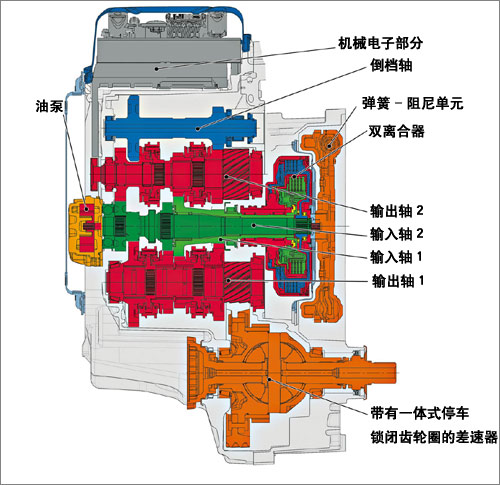
DSG dual clutch transmission also has two shift modes, manual and automatic. In addition to the operation of the shift handle, the steering wheel of the vehicle is also equipped with a manually controlled shift paddle. When the vehicle is driving normally, the two shift modes can be switched at any time. When the manual mode is selected, the DSG dual clutch transmission will not automatically upshift even if the accelerator pedal is pressed to the bottom without upshift operation. In addition, DSG dual-clutch transmission can also achieve slight hydraulic power loss and extremely short shift time during the shift process, which makes the whole shift process achieve the highest efficiency, thus reducing the energy loss and improving the acceleration performance and fuel economy of the vehicle.
●DSG dual clutch transmission adopts the traditional gear transmission structure with two clutches, six forward gears and one reverse gear as the power transmission parts, and there are two coaxial input shafts in the transmission. When the first gear starts, the clutch 1 is engaged, and the power is transmitted to the first gear set through the input shaft 1, and then output to the differential. At this time, the clutch 2 is still in the disengaged state, and no power transmission has been carried out, but the gear position is selected in advance to prepare for the next upshift. After the transmission enters the second gear, it exits the first gear, while the third gear is pre-engaged.
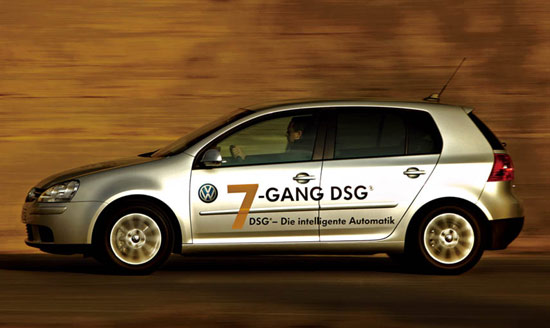
At present, Volkswagen has successfully used DSG dual clutch transmission on golf models.
When downshifting, two gears are also engaged. If 4th gear is working, 3rd gear is engaged as the pre-selected gear. In addition to neutral, DSG dual clutch transmission always has two gears engaged in the working process, one is working and the other is ready for the next work.
BMW M-DCT Dual Clutch Transmission
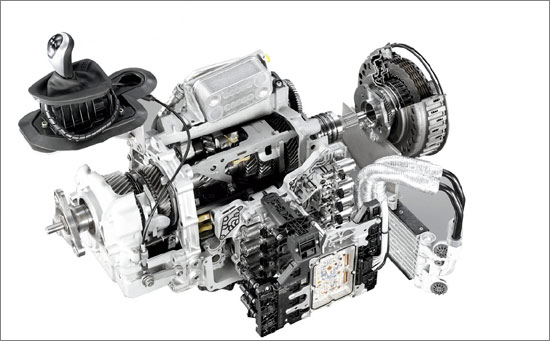
Through all-round technical cooperation with two famous professional transmission manufacturers, GETRAG and BorgWarner, BMW M Department has developed the latest M-DCT(DualClutchTransmission)7-speed dual clutch transmission specially designed for V8 engine with the maximum speed of 9000r/min on the basis of the 3rd generation SMG (Sequential Manual Box) sequential manual transmission. M-DCT dual-clutch transmission also adopts the internal structure design of two clutches, one clutch controls the gear set of odd gears in the transmission, and the other transmission controls the gear set of even gears. Before the shift operation, one clutch has engaged the gear set of the next gear in the transmission in advance. When shifting gears, one clutch is disconnected and the other clutch is immediately connected to the next gear, thus realizing almost uninterrupted shifting operation.
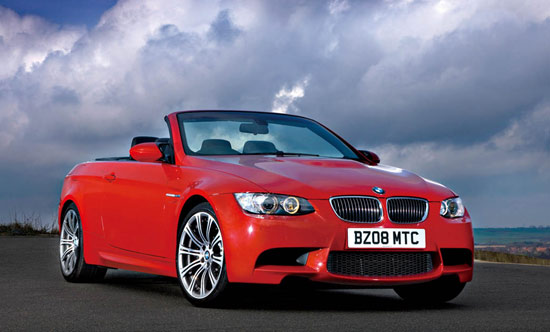
BMW’s new generation M3 roadster is equipped with M-DCT dual clutch transmission.
The structural principle of M-DCT dual-clutch transmission is based on the standard manual transmission, but the clutch pedal is omitted and the gear is operated by an electronically controlled hydraulic system. It is particularly worth mentioning that the M-DCT dual clutch transmission also adopts BMW’s unique Drivelogic shift logic system, which can change the shift mode to adapt to the driver’s personalized driving style. This Drivelogic shift logic system can provide 11 unique shift programs, including 6 manual shift programs and 5 automatic shift programs. By controlling the Drivelogic switch, the driver can choose the driving style that suits him at will among these 11 shift programs.
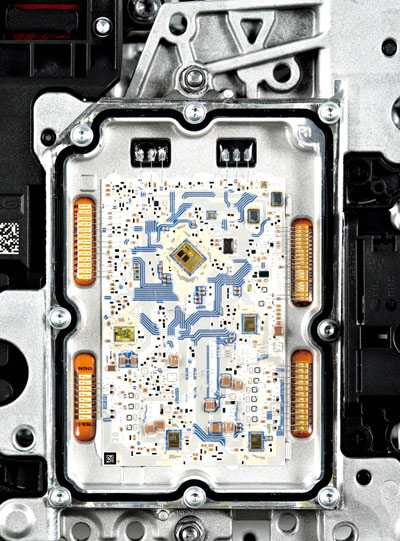
Electronic control unit of BMW M-DCT dual clutch transmission
At present, M-DCT dual clutch transmission has been first equipped on BMW’s latest generation M3 coupe and convertible. Moreover, according to the data released by the manufacturer, the acceleration time of M3 sports car with M-DCT dual clutch transmission from 0 to 100 km/h is only 4.6s, which is 0.2s higher than that with traditional manual transmission. It can be seen that the M-DCT dual clutch transmission can realize faster shift operation, thus making the vehicle obtain stronger acceleration performance.
Porsche PDK dual clutch transmission
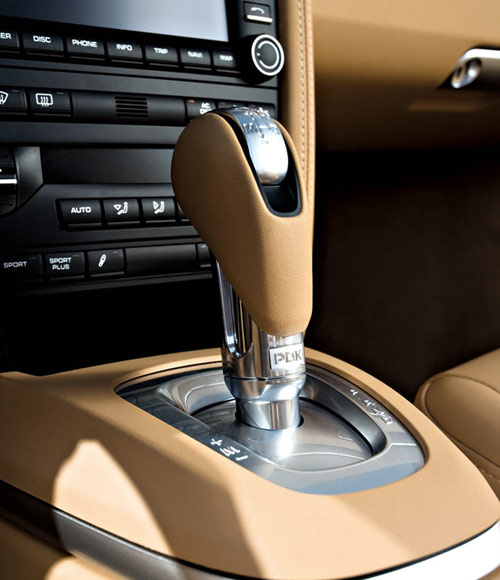
Porsche has always been a "master in the industry" using manual transmission and Tiptronic manual/automatic integrated transmission. Now, in addition to these two transmission types, Porsche PDK dual-clutch transmission gives Porsche more choices in powertrain matching. PDK is the German abbreviation of "PorscheDoppelKupplungen", which means "Porsche dual clutch transmission system" in Chinese. The structure and operation principle of Porsche PDK dual clutch transmission are the same as that of Volkswagen DSG dual clutch transmission, and it is also equipped with a manual shift paddle on the steering wheel, so that the driver can shift gears without leaving the steering wheel. At present, Porsche PDK dual clutch transmission has been equipped on Porsche 911Carrera and CarreraS models.