In 2017, China’s patent industry rose in quantity and quality, patent creation made steady progress, and China patents began to enter a new era of development.
From quantity winning to quality improving.

Panorama of FAST project. Xinhua News Agency reporter Liu Xushe
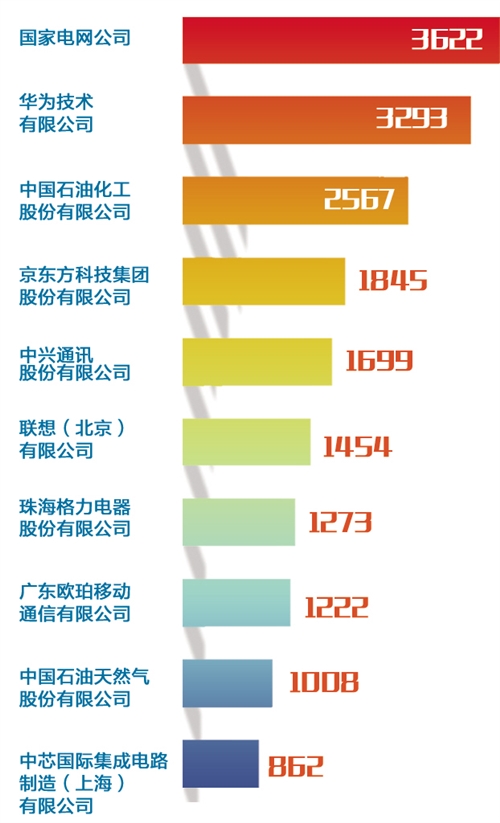
In 2017, the top ten enterprises (excluding Hong Kong, Macao and Taiwan) granted invention patents in China: pieces
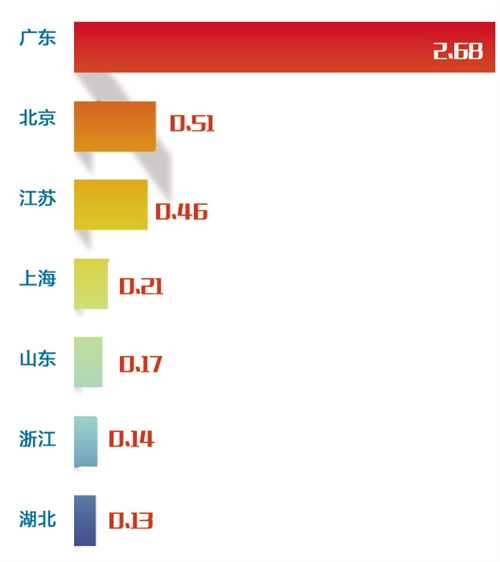
In 2017, provinces (autonomous regions and municipalities) with more than 1,000 PCT international patent applications: 10,000.
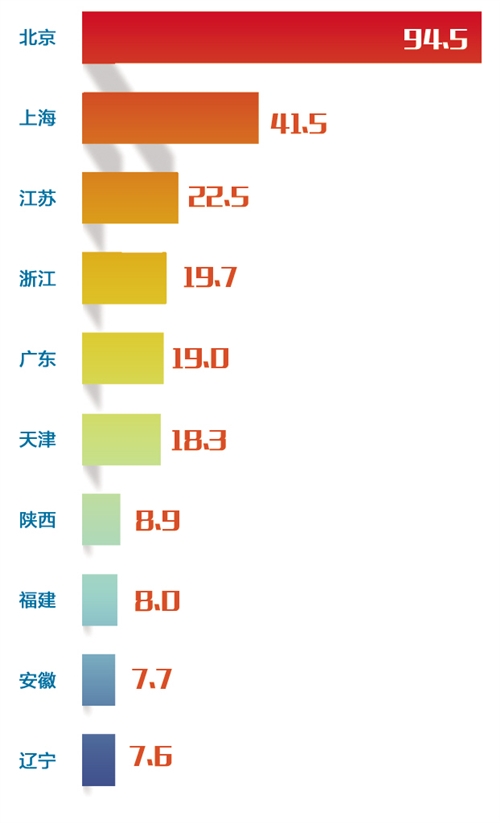
In 2017, the top ten provinces (autonomous regions and municipalities) with invention patents per 10,000 population in China: pieces
Although Chinese enterprises are growing rapidly in the fields of mobile communication, electronic information technology and chemical industry, the number of foreign invention patents in China is higher than that in China in five fields, such as optics, medical technology, engine, audio-visual technology and transportation.
Judging from the number of invention patents that have been maintained for more than 10 years, the number in China is still less than that in foreign countries in 29 technical fields, and it is still necessary to continue to cultivate high-value core patents in the above fields.
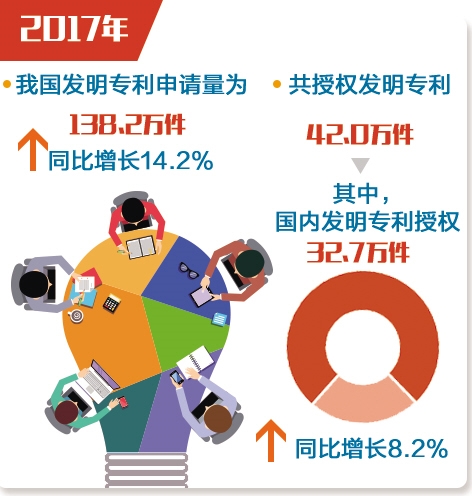
Recently, China National Intellectual Property Administration released the information about China’s invention patents and the ranking of enterprises in 2017. The data shows that in 2017, the number of invention patent applications in China was 1.382 million, a year-on-year increase of 14.2%. A total of 420,000 invention patents were authorized, including 327,000 domestic invention patents, an increase of 8.2%. The surging momentum of generate’s patent industry, which is rising in quantity and quality, has made the pace from a big intellectual property country to a strong intellectual property country more solid and powerful.
Innovation ability is increasing day by day.
Enterprises have performed very well in the application and authorization of invention patents. "In 2017, the proportion of domestic invention patent applications and ownership in China reached 63.3% and 66.4% respectively, up by 1.6 and 0.9 percentage points from 2016." Bi Nan, Director of China National Intellectual Property Administration Planning and Development Department, said.
In 2017, among the top ten enterprises in China (excluding Hong Kong, Macao and Taiwan) in the number of invention patents granted, there are both "frequent customers" like Huawei, Sinopec, ZTE and BOE, and also new industries like Opal. There are senior strength groups such as Gree Electric, Lenovo and State Grid, and rising stars such as SMIC.
"The ranking of the number of enterprise invention patents granted this time shows the latest progress of China’s innovation-driven development strategy from one aspect, and it is characterized by diversity in one word." Liu Haibo, a researcher at the Institute of Science and Technology Strategy Consulting of China Academy of Sciences, told the Economic Daily reporter that, just as biodiversity is a symbol of the ecosystem, the diversity of the top ten enterprises in the list indicates that China’s innovation ecosystem is becoming more and more active, more resilient and has greater potential for sustainable innovation.
Su Ping, dean of the Intellectual Property College of Chongqing University of Technology, believes that the list directly reflects that the innovation ability of some enterprises in China has been continuously strengthened, and the status of enterprises as the main body of intellectual property creation and application has become increasingly stable. Counting the ranking of invention patents granted by domestic enterprises, Huawei, ZTE, BOE, Opal and Lenovo are all technology-based enterprises focusing on communication and electronic information technology, occupying five seats in the top ten. At the same time, ZTE, BOE and Huawei are among the 100 innovative enterprise clusters in the "2017 Global Innovation Index" published by the World Intellectual Property Organization, which shows that Chinese enterprises are gradually occupying a dominant position in these fields.
In addition, as a representative of R&D-intensive enterprises, SMIC International Integrated Circuit Manufacturing (Shanghai) Co., Ltd. also ranks among the top ten with 862 invention patents. "This shows that enterprises can catch up as long as they attach importance to innovation and increase patent protection and application." Su Ping said.
Compared with the ranking of invention patents granted by domestic enterprises (excluding Hong Kong, Macao and Taiwan) in 2016, it is not difficult to find that the top five enterprises in the past two years are basically the same. In this regard, Su Ping explained that patent creation, application and authorization are closely related to the law of innovation and development. On the one hand, under the influence of the new round of global innovation competition leading paradigm, the above-mentioned enterprises put intellectual property strategy at the core of enterprise development and invested a lot of R&D power to carry out innovation, so the number of authorizations is naturally large; On the other hand, enterprises that have tasted the sweetness in the patent market pay special attention to patent layout, take patent protection measures for their innovative achievements, and add value to enterprises through patent operation, forming a virtuous circle from innovation to patent to benefit.
Pay more attention to quality improvement
Different from the past, this time China National Intellectual Property Administration only published the ranking of domestic enterprises’ invention patents granted, but did not publish the ranking of domestic enterprises’ invention patent applications. In this regard, China National Intellectual Property Administration spokesperson Hu Wenhui explained that the purpose of adjusting the disclosure content of patent statistical data is to further improve the quality of patents and give full play to the innovation-oriented role of patent statistical indicators.
"This really sends us a signal that China will pay more attention to the quality of patent applications." Su Ping said that judging from the proportion of China’s patents granted in the world, China’s patents have won in number and become a veritable intellectual property power, and the next step is to improve the quality. It is reported that by the end of 2017, the number of invention patents in China (excluding Hong Kong, Macao and Taiwan) totaled 1.356 million, and the number of invention patents per 10,000 population reached 9.8.
"The level of patent creation has progressed steadily, thanks to the fact that in recent years, China has paid more attention to improving the quality and efficiency of intellectual property while paying attention to improving the quantity of intellectual property." Bi Nan said that since the 18th National Congress of the Communist Party of China, China National Intellectual Property Administration has put forward the concept of "quality wins, quantity distribution" and started to implement the patent quality improvement project. Focus on the whole chain of patent work, formulate a series of targeted measures around important links such as patent application, agency, examination, protection and application, and improve the quality of patents with multiple measures. Improve the efficiency of patent application, create a good patent protection environment, and promote high-quality creation and high-value patent implementation.
"Eye of the Sky" sounding, "Dragon" going into the sea, "Kunlong" flying successfully for the first time, and high-speed rail running out of "China speed" … Driven by a series of measures, China’s patent creation has formed a good situation in which the quantity and quality have risen together. Among the 35 technical fields classified by the World Intellectual Property Organization, in 2017, the number of domestic invention patents was higher than that of foreign invention patents in China by 30. "But we should also be soberly aware that there are not many foreign enterprises applying for invention patents in China, and there is still a long way to go from quantity layout to quality victory." Su Ping said.
"The content of patent statistics released this time has changed significantly, which really conveys the judgment of the government authorities on the current patent situation and the signal of the next policy adjustment." Liu Haibo believes that at present, creating high-quality core patents should be listed as the top priority of China’s patent work, but the transformation process from winning by quantity to improving quality is long and even more painful.
Some areas need to be strengthened
Although Chinese enterprises have grown rapidly in the fields of mobile communication, electronic information technology and chemical industry, we should also see that there is still a gap between the patent layout in some fields and that in foreign countries. "At present, in the five fields of optics, medical technology, engine, audio-visual technology and transportation, the number of foreign invention patents in China is higher than that in China." Bi Wei said that from the perspective of maintaining the number of invention patents for more than 10 years, the number in China is still less than that in foreign countries in 29 technical fields, and it is still necessary to continue to vigorously cultivate high-value core patents in the above fields.
"If mobile communication, electronic information and other industries invest heavily in research and development, they can present technological achievements in a short period of time. In order to make a breakthrough in high-end manufacturing, we must make long-term breakthroughs in core technologies such as bearings, gears, reducers and transmission devices. " According to Tang Heng, director of Jiangsu Intellectual Property Research Center, the reason why China lacks patent layout in high-end equipment such as optics, transportation and engines is because of the lack of innovation accumulation in these fields.
Patents are strategic weapons for enterprises to control the market and participate in competition, while vigorously developing high-end equipment is the only way to promote the transformation and upgrading of traditional manufacturing industries. Therefore, patent layout in the field of high-end equipment plays a vital role in revitalizing China’s real economy. "Just like strategic weapons need long-term pre-research, high-input research and development, high-intensity testing and high-quality production, cultivating high-quality core patents in the fields of engines and transportation requires creative courage to climb and persistent innovation." Liu Haibo said.
A very important reason for the short patent maintenance time is that the quality of the patent itself is not high, the application value is low, and the demand for technology market is shrinking. "From the perspective of maintaining the number of invention patents for more than 10 years, we do have a certain gap with foreign countries, which also shows that the quality of patents in these technical fields in China is not high enough." Su Ping suggested that in the future, Chinese enterprises should increase investment in R&D, plan the patent layout in advance according to the development direction of technology, and provide good technology from the source of innovation. At the same time, we should further strengthen the ability of patent application and improve the level of patent industrialization.
"In the process of patent examination, the state should moderately shift the focus to the patent maintenance time. Enterprises should also pay more attention to the second or even multiple research and development of patents, aim at the forefront of the industry, constantly integrate business needs with patent creation, and give them stronger market functions, so as to effectively extend the patent maintenance time. " Tang Heng said. (Reporter Li Peng Da)